What is this about?
Semantic Job is a new and smarter way to match people with jobs. Instead of relying on rigid keywords, narrow categories, and imperfect filters, it matches candidates and roles based on actual meaning.
Job seekers can describe in natural language what they want to work on, what matters to them, and what kind of role truly fits. Based on that, they see jobs that are not just superficially similar, but genuinely relevant in substance.
Many search intentions cannot be captured with a few keywords. They are nuanced, personal, and only make sense in context. Semantic Job turns that context into something usable with modern AI, unlocking a much more intelligent kind of job discovery.
Why is it relevant?
The problem
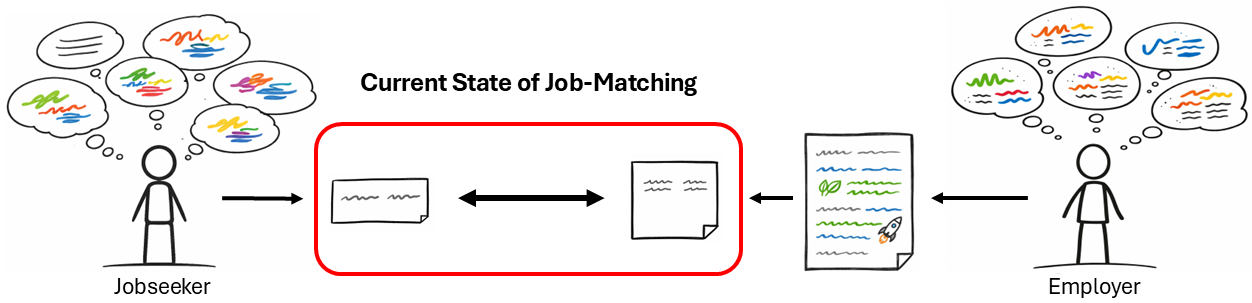
The illustration above shows the core weakness of current job matching: both job seekers and employers start with rich, highly individual information, but most of that complexity gets reduced before matching even begins.
On the job seeker side, individual strengths, interests, preferences, and potential are reduced to a few keywords. On the employer side, individual hiring needs are first compressed into a job posting, and then reduced again into a few keywords.
The actual matching, as shown in the red frame of the picture, then happens only between these simplified keyword representations rather than between the full realities of the person and the role. In that process, a huge amount of relevant information gets lost.
The result is inefficient and frustrating for everyone involved:
- Companies receive large numbers of poorly matched applications. Job seekers spend too much time searching, filtering, and applying without consistently finding roles that really fit. Both sides waste time, miss opportunities, and end up frustrated.
- Application spam and automated ATS rejections are not random side effects. They are clear signs of a matching system that is fundamentally limited in how well it can create real fit.
- The same issue appears at the market level: labor shortages and rising unemployment can happen at the same time. Companies cannot find the right people, while many people cannot find the right jobs. That is not just a labor market paradox. It is also a matching problem.
Why now?
The need for better job matching is bigger than ever:
- Jobs have become far more complex. Many roles can no longer be described well by a few categories or titles. Today's labor market is full of hybrid roles, specializations, and unique combinations that keyword-based systems struggle to understand.
- Location is no longer the same limiting factor. Remote work and increased mobility have expanded the search space dramatically. People are now comparing opportunities across cities, countries, and even global markets.
- Careers are more dynamic than before. Roles change faster, new job types emerge constantly, and career transitions are increasingly common. People need better tools to discover where they fit next.
And for the first time, this problem can be solved much better. Modern AI makes it possible to understand meaning instead of merely matching keywords. That changes what job search can be.
Benefits for companies
- Stronger candidate fit.
- More relevant applications instead of being flooded with badly matched ones
- A better way to communicate real hiring needs clearly and honestly, rather than hiding behind generic, buzzword-heavy job descriptions
- More efficient visibility through highly relevant search intent, instead of expensive competition around broad generic terms
Benefits for job seekers
- Better job fit.
- A more focused, more effective, and less stressful search process
- Better chances of successful applications and fewer repeated rejections
- Less time wasted on research, manual filtering, and trial-and-error searching
- Easier career transitions and stronger discovery of roles that often stay invisible in traditional systems
- Better access to jobs that are a strong real-world fit, even when they use different titles
FAQ
Not yet. This is a lightweight prototype built for fast learning, real user feedback, and rapid iteration.
A static selection of jobs jobs from Sweden.
These jobs are not updated regularly and may already be outdated. They are included only as a realistic demo data source.
No. That is a deliberate product decision.
We believe the highest-quality matching happens when job seekers search for jobs, not when people are expected to make themselves searchable through static public profiles.
Many important preferences are private, situational, and difficult to formalize. They also change over time. An active search captures what matters right now far better than a persistent candidate profile ever could.
That is why we focus on a model where companies describe opportunities publicly, while job seekers search privately based on what matters to them at this moment.
Yes.
Semantic Job enables a fundamentally different form of job matching. It allows both sides to express themselves more naturally and more precisely, making entirely new forms of fit and discovery possible.
Over time, this can reshape how people search, how companies express demand, and how the labor market connects work and talent.
At the same time, it is backward compatible. Neither side has to fully change behavior from day one to benefit. Traditional behavior still works, while better matching can already happen within it.